At 76, retired technician Ramaiah Vijayanaman has discovered the key to a happy and independent retirement: financial planning and disciplined spending.
“You have to save well and spend wisely. That’s why my wife and I don’t depend on our children for money,” he shared.
Mr. Vijayanaman worked with a security company until the age of 70, diligently building up his retirement savings. Even after retiring, he found ways to stay productive—earning some income during the COVID-19 pandemic by delivering food prepared by his wife to relatives.
His wife, Janaki, also 76, still works part-time in the packaging industry. The couple live with their third son in a four-room flat, managing their household budget carefully and maintaining savings for unforeseen circumstances.
Support from Government Schemes
During his working years, Mr. Vijayanaman benefited from the Workfare Income Supplement (WIS) Scheme, which boosts the income and CPF savings of eligible lower-wage workers. He also made full use of public support schemes like U-Save rebates, service and conservancy charges discounts, Medisave top-ups, and CDC vouchers provided through various national assistance programmes.
To cut daily costs, he prefers using public transport and benefited from $60 public transport vouchers issued to low-income households following fare increases in December 2024.
Monthly payouts from his retirement savings, combined with government support schemes, help him live comfortably. But financial security, he says, is not just about covering daily expenses—it includes being prepared for medical needs without financial anxiety.
When he suffered a minor stroke last year after a fall at work, his hospital bills were largely covered by the Pioneer Generation Scheme, with the remaining costs paid through Medisave. The scheme provides eligible seniors with annual Medisave top-ups ranging from $300 to $1,200, which can be used for insurance premiums under MediShield Life, CareShield Life, and ElderShield.
Like all Singaporean families, the Vijayanamans also benefit from CDC vouchers introduced in 2021. His wife used the $500 vouchers issued in May to purchase groceries and household essentials. Additionally, all Singaporeans aged 60 and above receive SG60 vouchers worth $800 in celebration of the nation’s 60th birthday, redeemable at businesses that accept CDC vouchers.
A Life of Hard Work
Mr. Vijayanaman’s journey is a testament to resilience and hard work. After completing vocational training at 16, he began his career at the Air Force Canteen. He was among the first Singaporeans to serve National Service and underwent an apprenticeship at Sembawang Shipyard while in the Vigilante Corps. He later joined the Navy, and after several years, moved to MRT Corporation (now SMRT), rising to the rank of Chief Engineer. His last major project was the Tanah Merah Link to Changi Airport before leaving the company at age 52 due to restructuring.
At a friend’s suggestion, he later obtained a security license and worked at the International French School in Singapore for over five years. “I even won the Best Security Guard Award during SG50,” he said proudly.
Eventually, long working hours took a toll on his health, and he retired at 70 after suffering a fall, heeding his son’s advice to stop working.
Adapting to a New Lifestyle
Upon retirement, Mr. Vijayanaman withdrew $20,000 from his personal savings and set the rest aside for emergencies. Initially unsure about their financial future, he and his wife made lifestyle changes to stretch their budget.
“We use public transport with our senior concession cards, even if it means leaving home earlier. Singapore’s system is reliable and much cheaper than driving,” he explained.
“We don’t buy new clothes unless necessary. My sons still get clothes for us, even though we’re content with what we have. If I refuse, they get upset,” he added with a laugh.
Staying Active and Giving Back
Despite health challenges, Mr. Vijayanaman and his wife remain actively involved in social work. Both volunteer at the Sree Narayana Mission Active Ageing Centre in Woodlands, where Janaki conducts cooking classes and he enjoys socialising with fellow seniors, especially in Malay.
He visits the centre weekly for yoga to support his stroke recovery. “Earlier, life was just work, home, and sleep. Now I’m more at peace,” he reflected.
He also enjoys visiting places of worship of different faiths to meet people and promote racial harmony.
Saving and Sharing
“Managing a home is like managing a country—you must plan and save,” he advises. “If you don’t start saving now, you’ll face bigger problems later.”
Mr. Vijayanaman also encourages others to give back instead of gambling. “Instead of spending on 4D, why not donate food to temples or to those in need in poorer countries?”
Today, he actively encourages fellow seniors to engage in activities at ageing centres. “When people say it’s too far, I point out the direct bus routes. Then they realise it’s actually convenient.”
He’s also preparing to train other seniors to become befrienders at the nearby Sree Narayana Mission Senior Care Centre. “Seniors like us need to know how to manage our money, live healthily, and most importantly, be independent,” he said.
He’s living proof that retirement success comes from planning early and staying engaged.
💡 Visit https://go.gov.sg/tfb-tm for programmes and resources to help you plan for retirement.
🧭 You can also explore the Together for Better roadshows held island-wide to begin your vibrant ageing journey.
Click here to read the article
Singapore’s Indian population is increasingly facing challenges such as an aging population, environmental protection, discrimination against foreign workers, and support for low-income families.
Dinesh Vasu Das, Minister of State for Culture, Community and Youth, Minister of State for Manpower and Mayor of South East District, emphasised the importance of Indian youth uniting and enhancing their skills to tackle emerging societal challenges.
Mr. Dinesh was the Guest of Honour at the Singapore Indian Development Association (SINDA) Youth Forum’s SINDA Young Leaders Seminar held on Sunday (15 June).
Commending the innovative thinking of young participants, Mr. Dinesh remarked that such initiatives offer a valuable, lifelong learning experience for Singapore’s Indian Youth.
“This is a crucial step in nurturing the next generation of Indian community leaders,” he said.
The three-day seminar, held at the Ridge View Residential College campus, saw the participation of nearly 80 students from various higher education institutions.
On the final day of the seminar, through a programme called ‘Echoes of Insight’, young participants used their creativity to share the social challenges they had experienced, the strategies they used to overcome them, and the key lessons they learned from them.
One of them, Anderson Serangoon Primary School student Abdul Rahim, 17, shared with Tamil Murasu his experience of visiting the Sree Narayana Mission Nursing Home with his group on Saturday (14 June).
“Elders are the backbone of every family. It is very important to learn from their life experiences,” said Rahim.
To commemorate Father’s Day, young volunteers assisted elderly residents at another nursing home in making Father’s Day cards.
“The experience of making Father’s Day cards with the elderly at the nursing home was an opportunity to connect with them. It was like talking to my grandparents,” said Reshma Sureshkumar, 23, a student at the Singapore University of Social Sciences.
He said that he was unable to meet and speak to his grandparents directly because both of them live in India.
Volunteer Balasundari Mamannan, 19, said that the wrong perspective on certain situations may change as young people have such social interests.
“This creates a desire among young people to help many communities,” he said.
Click here to read the article
In Singapore’s first general election in 1968, the People’s Action Party (PAP) won all 58 seats in Parliament. On Saturday (May 3), Singaporeans voted in the country’s 14th general election.
Among them was 97-year-old Maylvaganam Sabapathy, a resident of Sree Narayana Mission Nursing Home, who cast his vote on Saturday morning. He shared his memories of past elections with Tamil Murasu.
Mr. Maylvaganam recalled that as a young man living in the Serangoon constituency, he once stood as a candidate in an election, running against a PAP candidate who was regarded as having leftist views. He noted that the PAP candidate won that election by a narrow margin.
“Singapore has seen good development over the years,” he reflected.
Mr. Maylvaganam was one of several residents from Sree Narayana Mission Nursing Home who voted at various polling stations on Saturday.
Care staff accompanied six wheelchair-bound elderly residents to a nearby polling station at Block 734, Yishun Avenue 5. Sree Narayana Mission has also arranged for the remaining nine residents to vote at polling stations near their home addresses.
Suryakumaran Subramaniam, 86, a resident and former business owner, said the organisation had made the voting arrangements well.
“We were brought in carefully and with proper security. Voting was smooth. I extend my best wishes to the most deserving candidates,” he said.
S. Devendran, CEO of Sree Narayana Mission Nursing Home, said the home is committed to supporting residents who wish to vote.
“We arranged staff and transportation to assist residents going to the polling stations. The Elections Department also made various provisions, including wheelchair ramps, to help elderly and wheelchair-bound voters,” Mr. Devendran said.
Mahalakshmi Annamalai, 39, manager of Sunlove Home, said that elderly residents under their care were transported in wheelchairs to polling stations near their homes.
“We safely transported about 30 elderly residents to the polling stations. They were happy to be able to vote despite their limited mobility,” said Ms. Mahalakshmi.
Click here to read the article
SreeNarayana_Newsletter_139069_V2
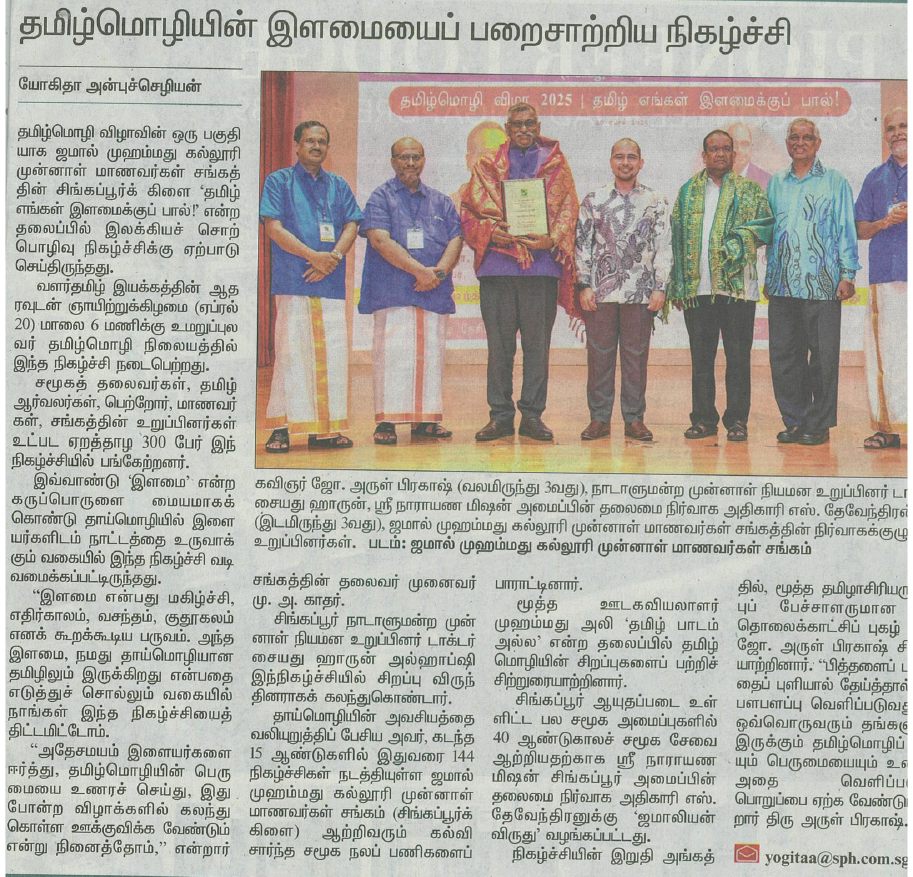
As part of the Tamil Language Festival 2025 celebrations, the Singapore Chapter of the Jamal Mohamed College Alumni Association organised a literary lecture titled “Tamil is the Milk of Our Youth!”
The event took place on Sunday, 20 April at 6.00pm at the Umar Pulavar Tamil Language Centre, with the support of the Valar Tamil Movement.
Approximately 300 people—including community leaders, Tamil activists, parents, students, and members of the association—participated in the event.
This year’s programme was specially curated to spark interest in the Tamil language among youth, with a focus on the festival’s central theme of “Youth.”
“Youth is a season that can be described as happiness, future, spring, and excitement. We planned this event to show that our mother tongue, Tamil, also embodies the essence of youth,” said Dr M. A. Kader, President of the association.
He added, “We wanted to attract the youth of this country, instil pride in the Tamil language, and encourage their participation in such cultural celebrations.”
During the event, the association announced that it would celebrate its 15th anniversary later this year.
Dr Syed Harun Alhabsyi, former Nominated Member of Parliament, attended as the special guest. Emphasising the importance of preserving the mother tongue, he praised the educational and social welfare initiatives of the Jamal Mohamed College Alumni Association (Singapore Chapter), which has organised 144 programmes over the past 15 years.
The event featured a student segment titled “Tamil and Youth”, with participants Ishaq Ibrahim, Amina Junaira, and Srinidhi Rengaprasad. Parents such as Mr G. Rengaprasad and Mrs Saradhamani also contributed to the discussion, highlighting the family’s role in sustaining the language.
A highlight of the programme was the musical performance of “Amude Tamile!” by renowned musician and singer Parasu Kalyan, accompanied by his students—Shruti Karthik, Sai Katyayani, Parasuraman Shai Siddhanth, Parasuraman Shai Vedhanth, Vyasan Venkatesh, Ishaan Karthik, and Akkshara Karthik.
Senior journalist Muhammad Ali delivered a short talk titled “Tamil is Not a Subject”, in which he emphasised that Tamil is not merely an academic subject, but a way of life and a core aspect of identity.
Mr S. Devendran, Chief Executive Officer of Sree Narayana Mission (Singapore), was honoured with the Jamalian Award for his four decades of community service across various organisations, including the Singapore Armed Forces.
In addition, a certificate of appreciation was presented to Abdul Rahman, a student of Yishun Town Secondary School, in recognition of his excellent performance in the GCE ‘O’ Level examinations.
The event concluded with a special address by veteran Tamil teacher and poet Joe Arul Prakash, known for his appearances on Vijay TV.
“The desire to develop the Tamil language does not need to be sought externally—it lies within us,” he said.
“Just as a brass vessel gleams when polished with tamarind, we must uncover and express the pride and love for Tamil that resides within our hearts.”
He concluded by affirming that Tamil, a language that guides human life, comforts the weary, inspires households, and conveys values suited for all ages, will continue to thrive for generations to come.
Click here to read the article
We have been made to believe that we need to be slim to be considered “healthy”. When we start an exercise routine, the results are measured based on numbers that appear on a scale, whether our clothes fit better, and when someone says “Hey! You’ve lost weight!”.
However, we are not defined by numbers on a scale or the size label on our clothes. In Ayurveda, we are seen as physical beings that are powered by Prana – the lifeforce of the Universe. Whatever is created by the Universe, is reflected and manifested in our body, mind, senses, and actions.

Ayurveda teaches us how to live a life that is filled with positive energy, presence, love, respect for nature, giving back to the community, and gratitude. This 5,000 year old system of medicine focuses on preventive care first before looking into treatment. It teaches us that we have the power to make mindful choices that can either keep us healthy and vibrant, or be susceptible to early onset disease.
To be perfectly honest, we are all susceptible to illness, disease, decay and death. It is the way of Nature. We are governed by Creation, Preservation and Destruction; the 3 laws and forces of Nature. How long we live, how well we live, is entirely in our hands and in the hands of those who care for us and vice versa. This comes down to learning about what foods are suitable for our body types based on our lifestyles, pace of life, country, and how well we sleep.
The 3 Pillars of Health in Ayurveda are Food, Sleep and Lifestyle. Food is something we need to give us energy to perform our roles in life with vigor and enthusiasm. Sleep is essential to rest our mind and body to prevent us from falling sick. Lifestyle allows us to choose how we want to participate in society, stay active, creative and curious. Any imbalance in these 3 pillars will result in us having digestive issues, low energy and bad sleep.
Here are some humble tips that can help us live a life that is simple, vibrant and joyful: Start your day with warm water on an empty stomach to wake up your digestive fire, stretch your body for 10 minutes, go for a 10 minute walk under the morning sun, take lukewarm showers, enjoy simple meals that are freshly cooked with local vegetables, meet your friends regularly to socialize, do your work with gratitude, spend a few minutes in silent prayer or meditation, let lunch be your biggest meal of the day, and keep things simple.
About the Author
Parnella is an Ayurveda Therapist, Trainer and Yoga Educator at Union Yoga Ayur veda. She provides therapeutic services to patients from all walks of life and facilitates Ayurveda and Yoga Therapy Foundation classes to sincere and curious students. She truly believes that Ayurveda and Yoga are for everyone. Whatever your species, race, age, occupation – there is something for everyone because these sciences are gifts to us from the Universe. It is through sincere studying, curiosity and unwavering faith that we can live a life that is present, mindful and joyful no matter the circumstance.
My old friend David and I have known each other since 1975, and met on a kibbutz by the Sea of Galilee when we worked as volunteers. Both now married and somewhat decrepit with grown-up kids, we have often escaped domestic life over the years to roam the mountains and valleys of Himachal Pradesh together, an area of India we both know and love.
Our latest sojourn was in April this year. We rendezvoused at Delhi domestic airport (he now lives in Australia, and I in Singapore) where a turboprop flight took us to Bhuntar. We then took a taxi to Tosh at the upper end of Parvati valley, driving through Kasol and Manikaram as we ascended to 10,000 feet. Our guesthouse boasted an uninterrupted view of the snow-capped ranges across the valley, almost unreal in their transcendental beauty.
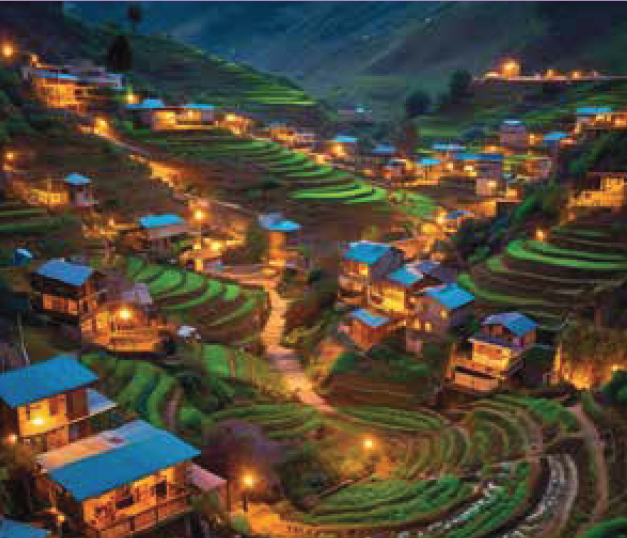
We used this as a base for a week to acclimatise, hiking the valley past pristine waterfalls in the cedar forests, and further up into the snow line where only Gurjar shepherds and the occasional lone bear or leopard dared venture. The town of Tosh itself has sprung up over old terraced fields where vegetables and fruits once thrived. The local population has largely succumbed to tourism during the past thirty years, with Tosh becoming a refuge for young Israelis escaping the stresses of home, the bass notes of trance music reverberating across the valleys deep into the night.
We took several hikes to the snow line but our advancing age soon took its toll. Gone were the days of scrambling over 16,000 ft passes in blizzards, and camping on cold hard rock. We congratulated ourselves on making the decision to take day hikes from a central base, to which you could return in the evening to a hot bath and a rejuvenating meal of dal, chapatti, rice and sabzi, the hiker’s standard fare. By 9 pm the cold set in and we would retreat to the cocoons of our cosy sleeping bags.
We met several interesting foreigners living in those foothills, escapees from the western world. But we decided that the Parvati valley no longer held the same mystique as it had a generation before, so we moved on to Chamba by bus, and after a comfortable night in the only good hotel in town, took a jeep to Tissa at the head of the valley. We found a friendly guest house with an excellent cook, and made our base there for ten days, hiking high up the valley slopes on both sides.
The lower slopes are intricately terraced, and farmers grew fruit and vegetables in the fecund black earth. The area is known for its apple orchards where several international strains are cultivated. We met an amiable horticulturalist who outlined the production process in detail, and who then invited us home for lunch.
This generosity is typical of the people in this area. A group of young men whom we first took for scallywags followed us for a while then shyly introduced themselves. They were all undergraduates at an agricultural university, home for a long weekend, and spoke fluent English. (David speaks appalling Hindi, and I, none at all). What was so refreshing about them was their obvious love of the countryside and rural tradition in that part of HP. They vowed to return to cultivate the land after graduation and to continue and improve the sustainable farming methods used by their forefathers. However, one of them had a different ambition; to join the police force. Apparently, this part of HP has a very low crime rate and it would be an easy job!
Tissa is well away from the tourist routes. We encountered no foreigners during the entire time we were there and the locals were open and generous. Indian tourists from the plains generally only venture as far as the large town of Chamba to witness the local festivals. Tissa area, a secret paradise, is a step too far for most. The access road is a nightmare, with dangerous landslides, strewn with crushed cars and trucks.
Logging in the Tissa area appears to be under control, and we hiked high through dense cedar and pine forests and higher into the snow. Though exhausting at times, the effort was always amply rewarded when we would find a place to sit in cool shade and look across the valleys toward the majestic mountains beyond, all the way to Kashmir, and to marvel at God’s creation.