This year, Royal Kings Group has not only supported several Iftar programmes but also organised a large-scale, prestigious Iftar gathering specially dedicated to community leaders.
The most recent event, held on Thursday, March 19 at De Centurion on Serangoon Road, extended meaningful support to low-income and needy individuals, providing $100 each to eight beneficiaries.
Dr. Syed Harun Alhabsyi, Senior Parliamentary Secretary for the Ministry of Education and the Ministry of National Development, graced the event as the Guest of Honour. The gathering drew approximately 200 attendees.
Earlier in the month, Royal Kings Group had already demonstrated its commitment to community welfare by fully supporting the reconciliation fasting event organised by the Singapore Indian Muslim Council on March 8. The group also served as the main sponsor for the Iftar event held by the Sree Narayana Mission Nursing Home on March 6.
At the heart of these generous initiatives is the company’s founder and CEO, Mr. Sirajuddin Syed Mohammed, whose dedication to social service continues to inspire the community. Royal Kings Private Limited, which began as a small company in 2013, has since grown into a prominent business group consisting of multiple subsidiaries — a testament to its remarkable progress.
Driven by a personal commitment to give back to society, Mr. Sirajudeen continues to set aside a portion of his income for charitable causes. His journey is guided by the strong moral values instilled by his parents, the unwavering support of his family, the companionship of close friends, and the encouragement of trusted associates.
As he expands Royal Kings Group’s global operations, Mr. Sirajudeen also continues to assist Singaporean Tamil organisations and numerous charities, extending both social and financial support across borders.
He also serves as the CEO of Nambikai Singapore, an initiative of Malaysia’s Nambikai daily online news outlet aimed at broadening its global presence. Under his leadership, the platform has reached audiences not only in Singapore but also in several other countries, earning the trust of Tamil communities worldwide.
Mr. Sirajudeen remains a strong supporter of the Manichudar daily newspaper of the Indian Union Muslim League. His contributions extend to Singapore as well, where he has provided advertising support to the Semmozhi magazine.
He also supports Singaporean Tamil Muslim literature, having funded the publication of two books by Semmozhi magazine editor M. Ilyas on Sirajul Millat Abdus Samad and Isaimurasu Nagore E.M. Hanifa.
His charitable efforts continue to benefit organisations across Singapore, Malaysia, and Tamil Nadu.
In recognition of his outstanding leadership and contributions to the Indian Muslim community, Mr. Sirajuddin was honoured with the SIRAT Global Golden Dinar Award 2026 on January 24, 2026. The ceremony, held in Kuala Lumpur, brought together 80 Singaporean representatives and over 800 Tamil and Muslim entrepreneurs from around the world.
Royal Kings Group and its leader are widely credited with connecting Singaporean businesspeople to global opportunities and creating new avenues for growth.
In addition to international recognition, Mr. Sirajudeen has received numerous awards in Tamil Nadu, including honours presented on stages graced by Tamil Nadu Chief Minister M.K. Stalin.
His continued commitment — both as a business leader and as a humanitarian — ensures ongoing recognition for the company’s achievements and his personal contributions.
Click Here to Read the Article
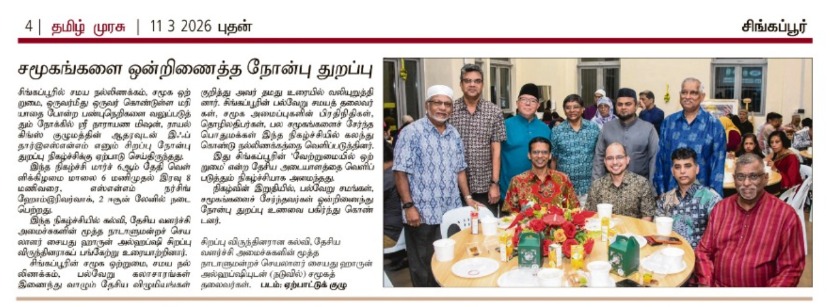
With the aim of promoting values such as religious harmony, social cohesion and mutual respect in Singapore, Sree Narayana Mission, with support by the Royal Kings Group, organised Iftar@SNM, a special breaking‑of‑fast event.
The event took place on Friday, 6 March, from 6pm to 8pm at the SNM Nursing Home @ Riverwalk, located at 2 Yishun Lane.
Dr Syed Harun Alhabsyi, Senior Parliamentary Secretary for the Ministry of Education and the Ministry of National Development, graced the occasion as the Guest of Honour. In his address, he underscored Singapore’s national values of social cohesion, religious harmony and the coexistence of diverse cultures.
Religious leaders, representatives from community organisations, business leaders and members of the public from various communities attended and demonstrated their solidarity. The event was a clear reflection of Singapore’s national identity of “unity in diversity”.
Click Here to Read the Article
To foster interfaith understanding, social cohesion and mutual respect within the community, Sree Narayana Mission (SNM), with the support of the Royal Kings Group, organised an Iftar (breaking of fast) gathering on 6 March.
Called Iftar@SNM, the event was held at the SNM Nursing Home @ Riverwalk, located at 2 Yishun Lane, and was graced by Dr Syed Harun Alhabsyi, Senior Parliamentary Secretary for the Ministry of National Development and the Ministry of Education, as the guest of honour.
Religious leaders, representatives from community organisations, business leaders and members of the public from diverse backgrounds also took part, contributing to the warm and vibrant atmosphere.
Click Here to Read the Article
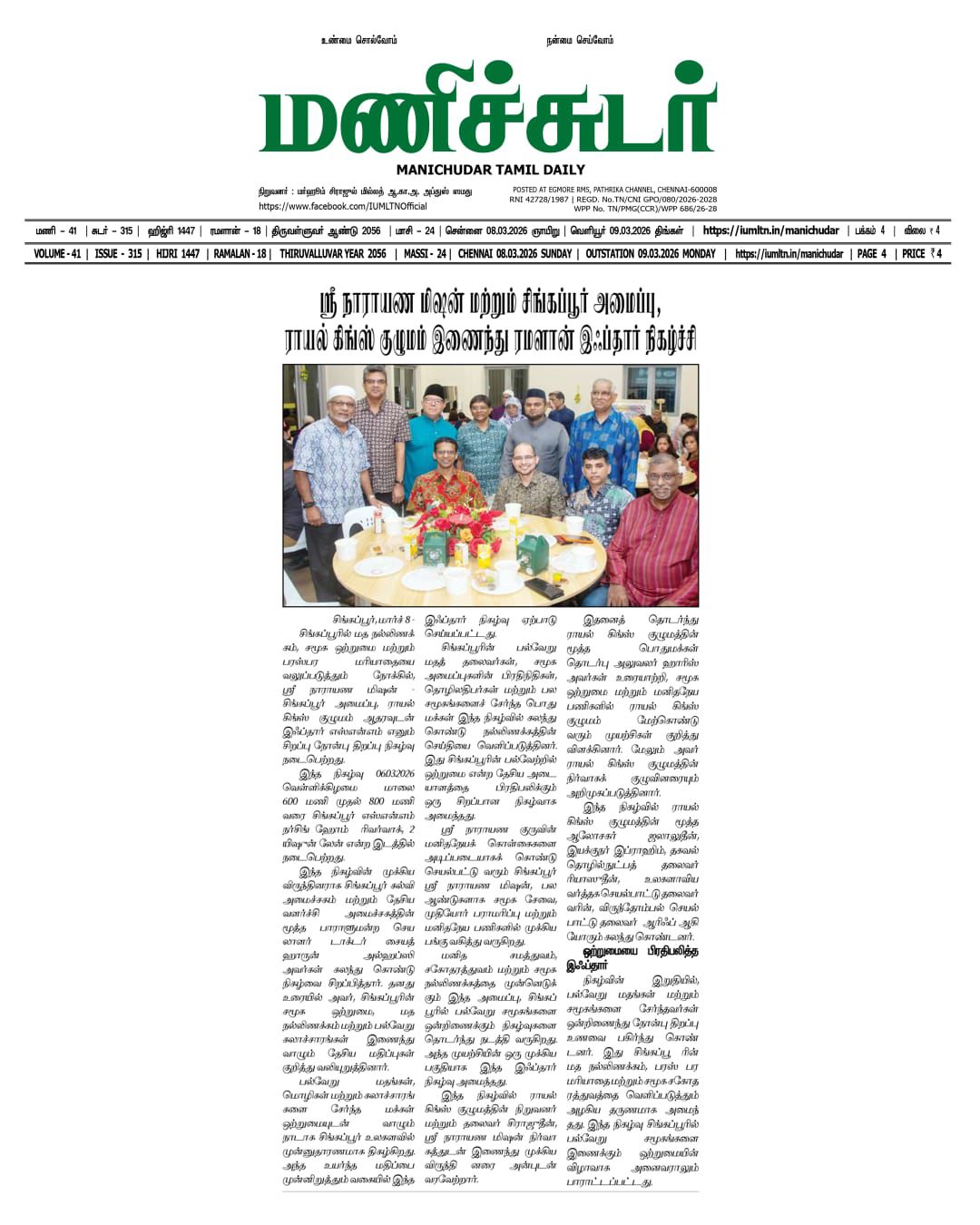
With the aim of strengthening religious harmony, social cohesion, and mutual respect across Singapore, Sree Narayana Mission (Singapore), in collaboration with the Royal Kings Group, successfully organised an Iftar gathering.
The event took place on 6 March 2026 (Friday) from 6.00 pm to 8.00 pm at the SNM Nursing Home@Riverwalk, located at 2 Yishun Lane.
Dr Syed Harun Alhabsyi, Senior Parliamentary Secretary for the Ministry of Education (MOE) and the Ministry of National Development (MND), graced the occasion as the Guest of Honour. In his address, Dr Harun highlighted Singapore’s core values of social cohesion, religious harmony, and the coexistence of diverse cultures.
“Singapore is a global example of a country where people of different religions, languages, and cultures live in harmony. This Iftar event was organised to highlight that profound value,” he said.
Religious leaders, representatives from community organisations, business leaders, and members of the public from various communities attended the event, echoing a strong message of harmony. It was a meaningful gathering that reflected Singapore’s national identity — unity in diversity.
Sree Narayana Mission (Singapore), guided by the humanitarian teachings of Sree Narayana Guru, has long played a significant role in social services, elderly care, and humanitarian initiatives. The organisation continues to champion human equality, fraternity, and social harmony through events that bring together Singapore’s diverse communities. This Iftar gathering formed an important part of that ongoing effort.
At the event, Mr Sirajudeen, Founder and Chairman of the Royal Kings Group, together with the management of Sree Narayana Mission, warmly welcomed the distinguished guests.
This was followed by an address from Mr Harris, Senior Public Relations Officer of the Royal Kings Group, who shared the organisation’s ongoing contributions to social solidarity and humanitarian programmes. He also introduced the Royal Kings Group’s management team.
Royal Kings Group Senior Advisor Mr Jalaluddin, Director Mr Ibrahim, Head of IT Mr Riyazuddin, Head of Global Business Operations Mr Warin, and Head of Hospitality Operations Mr Arif were also present to lend their support.
An Iftar That Reflected Unity
The event concluded with individuals from different religions and communities coming together to share a meal to break their fast.
It was a touching moment that highlighted Singapore’s religious harmony, mutual respect, and social fraternity.
The gathering was widely appreciated as a celebration of unity, bringing together the many communities that form the fabric of Singapore.
Click Here to Read the Article